
Joint Health & Nutrition Science
Why GLX3's Omega Profile Is Different From Fish Oil
The real answer to the question we get in the comments every week — and why it turns out to be more interesting than a ratio.
Haka Life Nutrition · Supplement Science · 7 min read
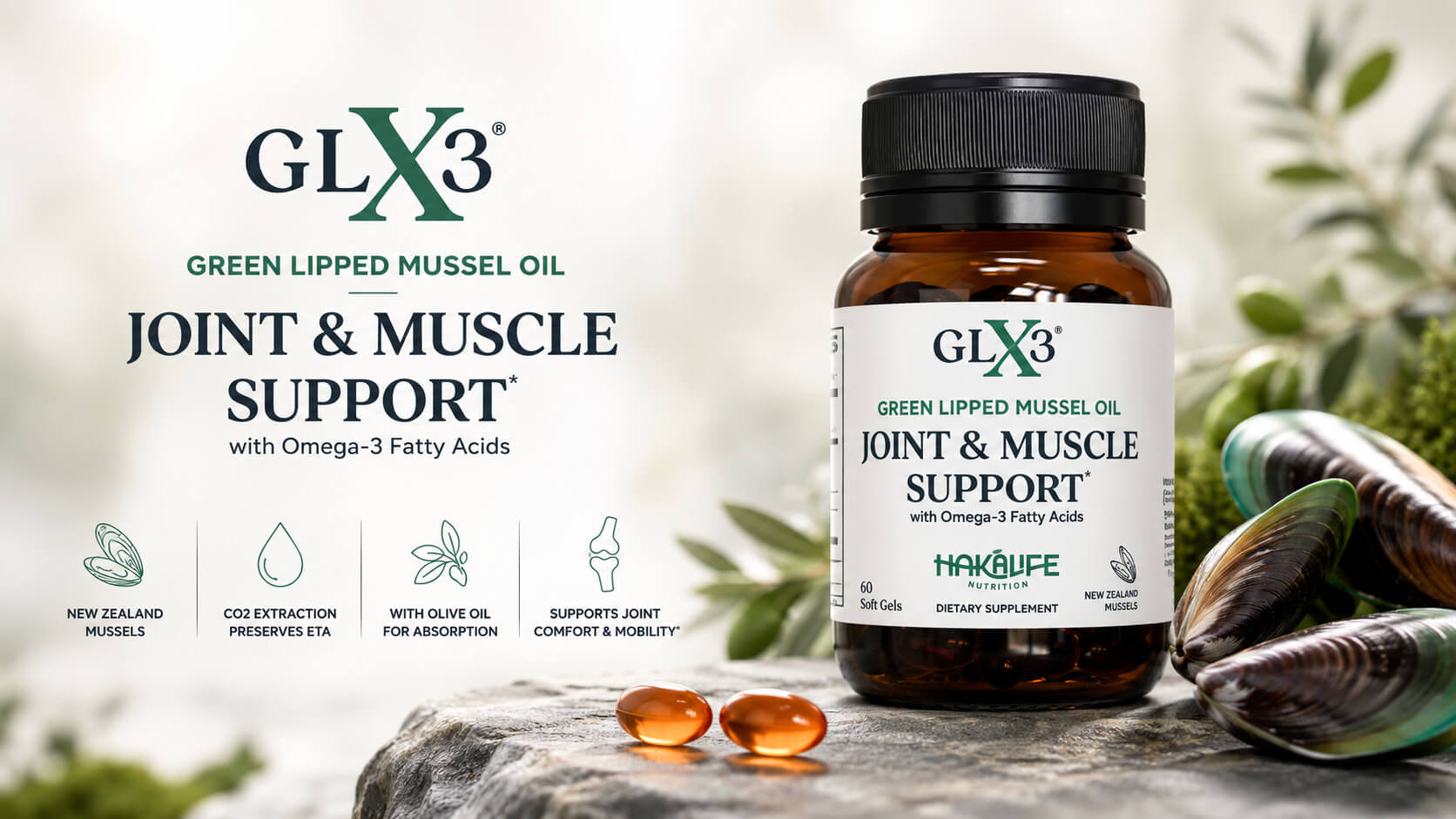
We get this question a lot on Facebook — someone sees a post about GLX3 and asks: "But what's the Omega-3-6-9 ratio?" It's a smart question. It just turns out the ratio is the beginning of the story, not the whole thing.
Here's what we love about customers who ask this — they've done their homework. They've read something about how the average Western diet is loaded with Omega-6 and light on Omega-3, and they're trying to figure out if GLX3's profile supports that balance. It does. But the why is what makes green-lipped mussel oil genuinely special.
Let's start with the data, then we'll get to the part that matters most.
The Ratio — What the Lab Actually Shows
Our COA (Certificate of Analysis) for GLX3, verified through Eurofins, puts the Omega-3 to Omega-6 ratio at roughly 2.4 : 1 per two-softgel serving. That's meaningful — and it's directionally the opposite of how most people eat.
Omega-3 to Omega-6 Ratio — Favorable Direction = Higher
GLX3 (Green-Lipped Mussel)
COA-verified per serving
2.4 : 1
Standard Fish Oil
Typical concentrate
~3 : 1
Average Western Diet
Processed foods, vegetable oils
1 : 15
The average American diet runs somewhere around 1:15 in favor of Omega-6 — largely because of processed foods, vegetable oils, and fast food. That imbalance matters for how your body supports its natural inflammatory response. GLX3's profile works in the right direction.
But here's where we have to tell you something most supplement companies won't: the ratio alone isn't the most important thing.
Meet ETA — The Omega-3 That Fish Oil Doesn't Have
When you take a standard fish oil supplement, you're getting two Omega-3 fatty acids: EPA and DHA. Both are well-studied Omega-3 fatty acids with established roles in supporting cardiovascular and inflammatory health as part of a balanced diet.* But green-lipped mussel oil adds something fish oil simply cannot — a rare Omega-3 called ETA (eicosatetraenoic acid).
ETA is found in meaningful concentrations in almost no other natural source on earth. It's one of the things that makes New Zealand green-lipped mussels extraordinary — and it's one of the primary reasons researchers have studied this marine lipid so intensively over the past several decades.
"Fish oil works on one pathway. ETA works on two — and that's not a small distinction when it comes to supporting your body's natural inflammatory response."
— Haka Life Nutrition
Here's the slightly technical part, but stay with us — it's worth it.
Your body manages its natural inflammatory response through two main enzymatic pathways: the COX pathway and the LOX pathway. Standard fish oil — specifically EPA — primarily supports healthy function through the COX pathway. ETA is one of the only known naturally-occurring fatty acids that supports both pathways simultaneously.* That's a meaningful difference in how broadly it supports your body's natural inflammatory response.
Science Note
ETA's dual COX/LOX activity is one of the reasons green-lipped mussel lipid extract has been the subject of multiple peer-reviewed studies on joint comfort and mobility support — particularly in aging populations.* GLX3 is formulated specifically to preserve ETA through CO2 extraction rather than heat or solvent methods that can degrade it.
The Full Omega-3 Complex in GLX3
Beyond ETA, GLX3 delivers a broader Omega-3 profile than fish oil in its whole-food form:
| FATTY ACID | STANDARD FISH OIL | GLX3 (GREEN-LIPPED MUSSEL) |
| EPA (Eicosapentaenoic) | ✓ Present | ✓ Present |
| DHA (Docosahexaenoic) | ✓ Present | ✓ Present |
| ETA (Eicosatetraenoic) | ✗ Not present | ✓ Naturally occurring |
| DPA (Docosapentaenoic) | ✗ Typically absent | ✓ Present |
| ALA (Alpha Linolenic) | ✗ Not present | ✓ Present |
| COX pathway support | ✓ | ✓ |
| LOX pathway support | ✗ | ✓ Via ETA |
| Native lipid matrix (whole food form) | ✗ Processed isolate | ✓ Preserved via CO2 extraction |
Why Bioavailability Changes Everything
You can have the best Omega profile on paper — but if your body can't absorb it, it doesn't matter. This is where GLX3's formulation decisions compound on each other.
CO2 Supercritical Extraction
Most fish oil is extracted using heat or chemical solvents. Both methods degrade fragile compounds — including ETA — and strip away the natural phospholipids and sterols that actually help your body recognize and absorb fat-soluble nutrients. GLX3 uses CO2 supercritical extraction: no heat, no solvents, just pressure. The full lipid complex arrives intact.
The Olive Oil Is Doing Real Work
The single-origin New Zealand olive oil in each GLX3 softgel isn't filler — it's functional. Omega-3 fatty acids are fat-soluble, meaning they absorb significantly better in the presence of healthy dietary fats. The olive oil serves as a natural lipophilic carrier, enhancing the bioavailability of the marine lipid complex it's paired with. That's an intentional formulation decision, not an afterthought.
Native Phospholipid Form
Standard fish oil is typically sold as re-esterified triglycerides — a processed molecular form that requires an extra conversion step before your body can use it. GLX3's marine lipid complex arrives in its native phospholipid form, the same structure your body recognizes from whole food. Less conversion means better utilization.
The Simple Version
It's a bit like the difference between eating a whole orange versus taking a Vitamin C pill. Both have the vitamin. But the whole orange comes with everything your body uses to actually absorb it. GLX3 is the whole orange.
So — Is the Omega Ratio Good?
Yes. A 2.4 : 1 Omega-3 to Omega-6 ratio is meaningfully favorable, especially compared to the average diet. It's working in the right direction for people who want to support their body's natural inflammatory response.
But the ratio, on its own, undersells what GLX3 actually delivers. The combination of ETA's dual-pathway activity, CO2-preserved lipid integrity, native phospholipid absorption, and olive oil bioavailability enhancement — that's what makes this formula genuinely different from putting a fish oil capsule on your kitchen counter.
When someone asks us about the Omega ratio in the comments, we try to give them the honest version: the number is good, but the story behind it is better.
Two softgels a day — that's all it takes to give your body the joint support it deserves.*
See what GLX3 can do for you.
Try GLX3 — 90 Days, Risk-Free
SHOP NOWFree shipping on orders over $50 · 90-day money-back guarantee
*These statements have not been evaluated by the Food and Drug Administration. This product is not intended to diagnose, treat, cure, or prevent any disease. References to COX/LOX pathway support, joint comfort, and mobility reflect the ingredient's role in supporting the body's natural inflammatory response as part of a healthy lifestyle — not clinical outcomes. Individual results may vary.
Haka Life Nutrition · 18484 Preston Rd., Ste 102 PMB 256, Dallas, TX 75252 ·

